
AMITRIPTYLINE SIDE EFFECTS: WHAT GENETICS EXPLAINS, AND WHAT IT DOESN'T
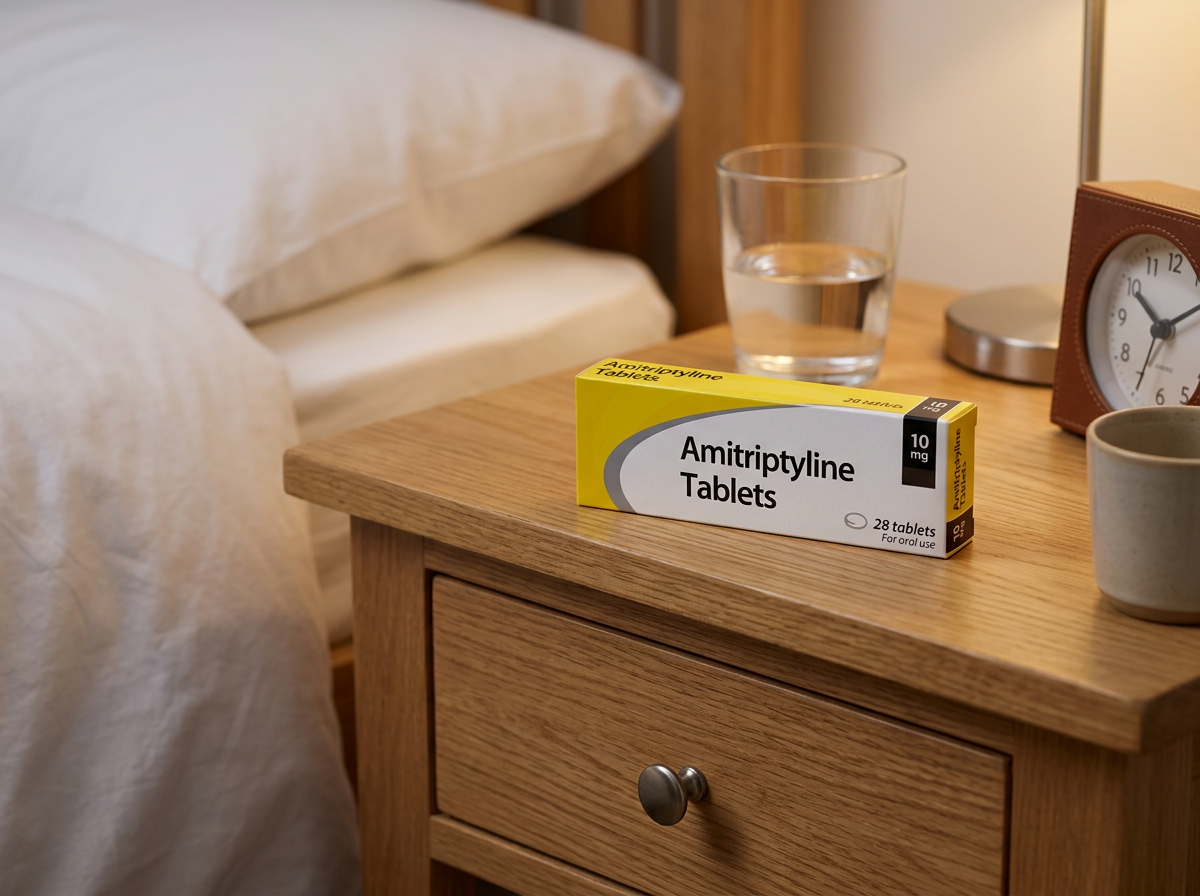
Most people in the UK who take amitriptyline are not taking it for depression.
It's prescribed at low doses for neuropathic pain, migraine prevention, tension headache, IBS and sleep. NICE includes it among the options for neuropathic pain and for migraine prophylaxis. The doses used are a fraction of what was originally used to treat depression.
At those low doses it helps a lot of people. It also produces a familiar set of complaints: dry mouth, grogginess that lasts into the next morning, constipation, feeling slightly disconnected. Some people get all of that at 10mg. Others feel nothing at all at four times the dose.
Genetics explains part of that gap. It does not explain all of it, and the honest answer about how much it explains depends on why you're taking the drug.
What Your Body Does With Amitriptyline
Amitriptyline is unusual in that it becomes a second active drug inside you.
An enzyme called CYP2C19 converts part of it into nortriptyline, which is itself a prescribed antidepressant with a different balance of effects. A second enzyme, CYP2D6, then clears both compounds out.
So two separate genetic variables are in play. CYP2C19 influences the ratio of amitriptyline to nortriptyline in your blood. CYP2D6 influences how fast the whole lot is removed.
Someone with slow CYP2D6 accumulates more of both, which tends to mean more anticholinergic effects at any given dose. Someone with very fast CYP2D6 may clear the drug before it does much of anything.
Both enzymes vary substantially between individuals, and the variation is inherited.
The Side Effects People Actually Stop For
The ones that end treatment are rarely dramatic.
Dry mouth. Constipation. Blurred vision. Morning drowsiness after an evening dose. Dizziness on standing. Weight gain. Urinary hesitancy, particularly in older men.
These come from amitriptyline's anticholinergic and antihistaminergic activity rather than from its pain-relieving mechanism, which is why they can appear well before any benefit does. In older adults they matter more, because they add to overall anticholinergic burden and are associated with falls and cognitive fog.
If you are getting a strong dose of these effects at a dose your prescriber considers very low, reduced clearance is one credible explanation.
That is not a reason to adjust or stop the medication yourself. Amitriptyline should be reduced gradually rather than stopped abruptly, and any change belongs with your prescriber.
Why the Dose Changes the Genetic Picture
This is the part that usually gets glossed over.
The pharmacogenomic evidence for amitriptyline was built largely on depression-level dosing, which is several times higher than the doses used for pain and sleep. At those higher doses the genetic effect on blood levels is large enough to warrant changing the dose.
At low doses, the guideline position is different, and more cautious. CPIC does not recommend dose modification for poor or intermediate metabolisers when amitriptyline is used for neuropathic pain. The exposure differences are real, but the doses are low enough that the evidence doesn't support a specific adjustment.
What does survive at low doses is the efficacy question. If you clear the drug unusually fast, a low dose may never do anything, and no amount of persistence changes that.
So the useful question at pain doses isn't "what dose should I be on". It's "is this drug likely to work for me at all, and am I likely to feel rough on it".
What the Guidelines Say
Amitriptyline is demethylated by CYP2C19 to nortriptyline, and both are hydroxylated by CYP2D6. CPIC's tricyclic guideline uses amitriptyline and nortriptyline as its model drugs.
For depression-level dosing, CPIC advises considering a 25% reduction in starting dose for CYP2D6 intermediate metabolisers.
For CYP2D6 poor metabolisers, CPIC advises avoiding tricyclics because of adverse effect risk. If one is still warranted, consider a 50% reduction in starting dose with therapeutic drug monitoring.
For CYP2D6 ultrarapid metabolisers, CPIC advises avoiding tricyclics because of likely lack of efficacy.
For CYP2C19 poor metabolisers, CPIC advises avoiding tertiary amines including amitriptyline because of the altered amitriptyline to nortriptyline ratio. If still warranted, consider a 50% reduction with monitoring. The CYP2C19 ultrarapid recommendation is classed as optional, as the clinical significance of CYP2C19*17 is not well established.
CPIC states these dosing recommendations apply only to the higher initial doses used for conditions such as depression. For neuropathic pain at lower initial doses, CPIC does not recommend dose modification for poor or intermediate metabolisers on either gene.
The one pain-specific recommendation, classed as optional, is to consider an alternative in CYP2D6 ultrarapid metabolisers given the higher risk of therapeutic failure.
Where both genes return non-normal phenotypes, evidence is limited and therapeutic drug monitoring is advised.
Where a PGx Test Genuinely Helps
For low-dose amitriptyline, testing is most useful for two things: identifying people unlikely to respond because they clear the drug too quickly, and flagging reduced clearance as a likely explanation when someone is unusually sensitive at a minimal dose.
It becomes considerably more useful if amitriptyline is being escalated towards higher doses, or if a switch to nortriptyline or another tricyclic is being considered, because that is where the dosing recommendations start to apply.
It is also worth remembering that CYP2D6 and CYP2C19 between them affect a long list of other medicines, including several antidepressants, codeine and tramadol, and some heart drugs. A result obtained for one question answers several others permanently.
What it cannot do is tell you whether amitriptyline will relieve your pain. Pain response depends on far more than drug levels.
When to Consider Testing
Amitriptyline has done nothing for you across an adequate trial
You get marked side effects at the lowest available dose
You've had similar trouble with other medicines, particularly codeine, tramadol or antidepressants
Your dose is being increased towards antidepressant-level dosing
You're older, taking several medicines, and anticholinergic burden is a concern
A switch to nortriptyline or another tricyclic is on the table
Knowing Before You Start, Not After
Amitriptyline is a genuinely useful drug that a lot of people abandon in the first fortnight.
Some of those people were always going to struggle with it, and that was knowable in advance. Others were never going to get enough of it into their system to find out whether it worked.
Mantara's Pharmacogenomic (PGx) test looks at CYP2D6, CYP2C19 and other genes involved in drug metabolism. It won't tell you whether amitriptyline will help your pain. It will tell your clinician how your body is likely to handle it, and which related medicines are worth trying if it doesn't suit you.