
CITALOPRAM AND ESCITALOPRAM: WHY THE MAXIMUM DOSE ISN'T THE SAME FOR EVERYONE
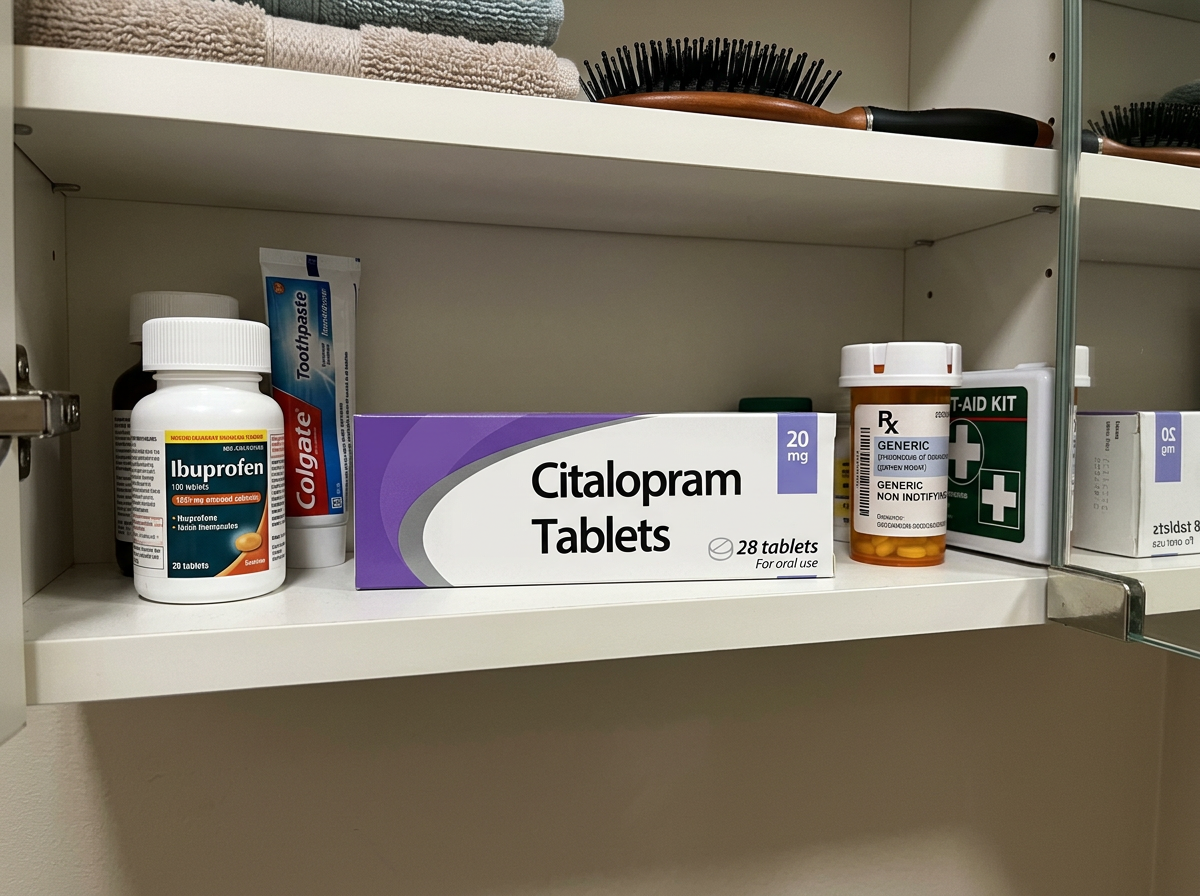
Citalopram is one of the most prescribed antidepressants in the UK. Escitalopram is its close relative, containing only the active half of the same molecule.
Both come with something most antidepressants don't have: a hard ceiling on the daily dose, set by the regulator rather than by the prescriber's judgement.
That ceiling exists for a specific reason, and the reason is about drug levels in the blood. Which makes it worth asking a question that standard prescribing doesn't currently answer: what if your blood levels at a given dose are much higher, or much lower, than the average person's?
For a substantial minority of people, they are.
Same Dose, Different Blood Levels
Citalopram and escitalopram are broken down primarily by CYP2C19, an enzyme whose gene varies widely between individuals.
Some people carry variants that reduce or eliminate enzyme activity. They're poor metabolisers, and they clear these drugs slowly, reaching higher concentrations on a standard dose.
Others carry variants that increase activity. They're rapid or ultrarapid metabolisers, and they clear the drugs faster, reaching lower concentrations on the same dose.
This is measurable, well documented, and fixed for life. It's also not routinely known at the point of prescribing.
Why There's a Dose Ceiling At All
Citalopram and escitalopram both prolong the QT interval, an aspect of the heart's electrical cycle. The effect is dose-dependent: more drug, more prolongation.
Following an MHRA safety review, UK maximum daily doses were restricted. For citalopram that is 40mg in adults and 20mg in people over 65 or with hepatic impairment. For escitalopram it is 20mg in adults and 10mg in people over 65 or with hepatic impairment.
Both drugs are contraindicated in congenital long QT syndrome, in known QT prolongation, and alongside other medicines that prolong the QT interval.
These are sensible, evidence-based limits. They are also population averages.
The Gap in the Rule
Look at why the limit is lower in older adults. The MHRA guidance is explicit: older patients have higher exposure because metabolism and elimination decline with age, so the ceiling comes down.
In other words, the rule already adjusts the maximum dose according to predicted drug exposure. Age is used as the proxy for that exposure, because age is something a prescriber always knows.
CYP2C19 status is another recognised driver of exposure to these drugs. It simply isn't usually known, so it doesn't enter the calculation the way age does.
That's an unusual situation: a well-characterised factor affecting drug exposure, in a context where exposure is precisely what the rules are written to control.
Sometimes It's the Opposite Problem
The exposure question runs both ways.
Ultrarapid metabolisers show lower citalopram and escitalopram concentrations than normal metabolisers, and CPIC notes they may experience less symptomatic improvement as a result.
For someone in that group, the experience is of an antidepressant that simply doesn't do much, followed by a dose increase, followed by hitting the ceiling with the drug still not working. That looks like treatment resistance. Sometimes it's pharmacokinetics.
What the Guidelines Say
Citalopram and escitalopram are metabolised primarily by CYP2C19. Escitalopram is the S-enantiomer of citalopram, and the same pathway applies to both.
CPIC's 2023 serotonin reuptake inhibitor guideline covers CYP2D6, CYP2C19, CYP2B6, SLC6A4 and HTR2A, and gives specific recommendations for both drugs.
For CYP2C19 poor metabolisers, CPIC recommends considering a 50% reduction in starting dose, with slower titration, or an alternative antidepressant not predominantly metabolised by CYP2C19.
For CYP2C19 rapid and ultrarapid metabolisers, CPIC recommends considering an alternative, noting insufficient data to calculate an appropriate increased starting dose.
For CYP2C19 intermediate metabolisers, existing data do not support adjusting the starting dose, though slower titration may be warranted given reduced metabolism.
The 50% starting dose reduction for CYP2C19 poor metabolisers also appears in the citalopram product labelling, independent of CPIC.
CPIC assessed SLC6A4 and HTR2A, the pharmacodynamic genes marketed by some providers as antidepressant response predictors, and did not support their clinical use.
What This Doesn't Mean
A poor metaboliser result is not a reason to stop an antidepressant, and it is not a diagnosis of anything.
Plenty of people who metabolise these drugs slowly do perfectly well on them, particularly at lower doses. The information matters most at the point of choosing a drug and setting a dose, and when someone is struggling and nobody can work out why.
Antidepressants should not be stopped or reduced abruptly. Discontinuation symptoms are common and can be unpleasant, and any change belongs with the clinician who prescribed it, planned and tapered.
When Testing Is Worth Considering
You've had side effects on citalopram or escitalopram that felt out of proportion to a low dose
You've reached the maximum dose without adequate benefit
You're over 65, or take other medicines that affect the QT interval
You've tried more than one SSRI without a clear result
You're about to start treatment and would rather not find out by trial and error
You take several medicines that share the CYP2C19 pathway, including some acid-suppressing drugs
Getting the Dose Right the First Time
The dose ceilings on citalopram and escitalopram are a good example of medicine responding to evidence. They protect people, and they should be respected.
They also assume everyone converts a given dose into roughly the same blood level, which is the one thing that reliably isn't true.
Mantara's Pharmacogenomic (PGx) test includes CYP2C19. It won't tell you which antidepressant will make you feel better. It will tell your clinician where your likely drug exposure sits relative to the average, which is exactly the variable those dose limits were written around.