
CODEINE AND TRAMADOL: THE PAINKILLERS THAT DEPEND ON A GENE YOU'VE PROBABLY NEVER BEEN TESTED FOR
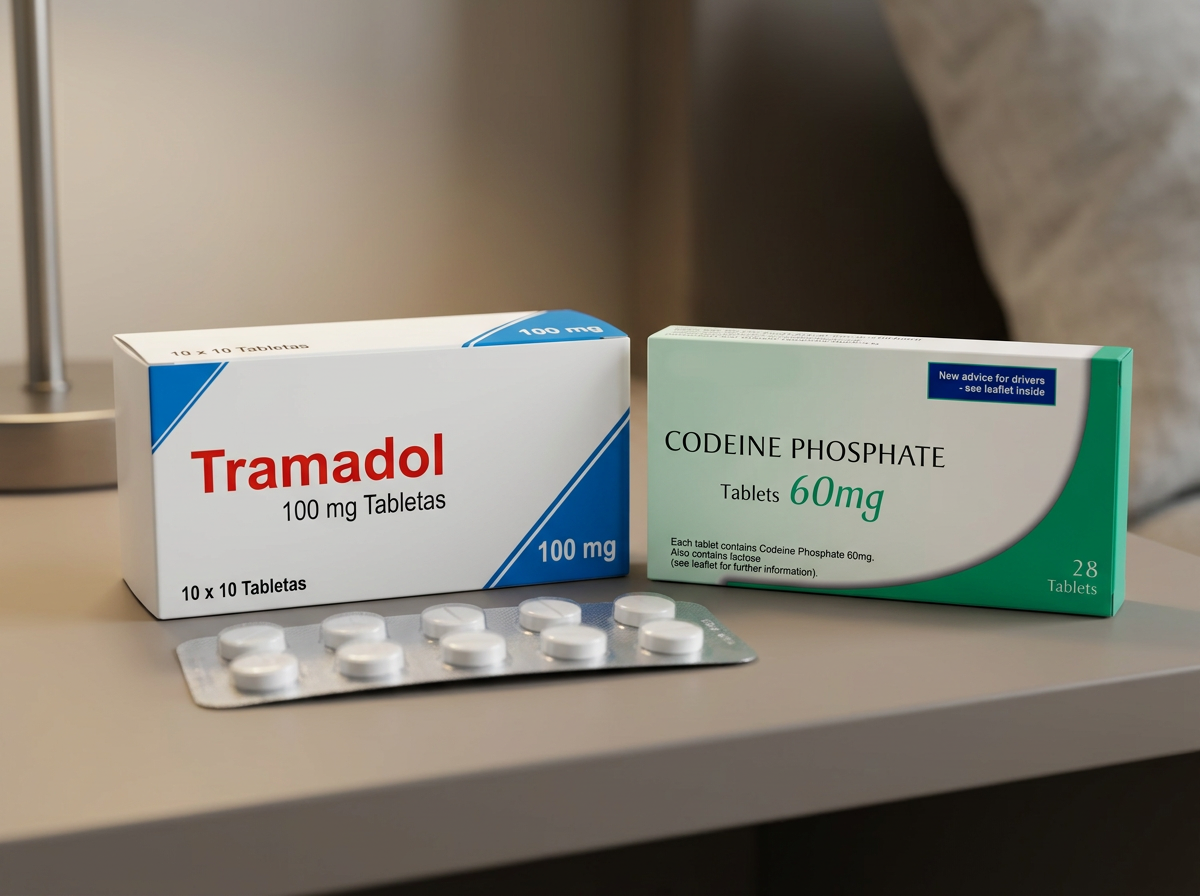
Codeine and tramadol are among the most widely used painkillers in the UK. Codeine turns up in co-codamol, in cough preparations, and in prescriptions for pain that paracetamol alone hasn't touched. Tramadol is prescribed for moderate to severe pain across primary and secondary care.
They share a feature that most people taking them have never been told about.
Neither drug does much of anything in the form you swallow. Both have to be converted by a liver enzyme into the compound that actually relieves pain. That enzyme is CYP2D6, and it is one of the most variable genes in the human genome.
If your version of it works unusually slowly, codeine may do nothing at all. If it works unusually fast, a standard dose can behave like a much larger one.
Nothing Happens Until Your Body Converts It
Codeine is a prodrug. CYP2D6 converts a small fraction of it into morphine, and it's the morphine that provides analgesia.
Tramadol works the same way. CYP2D6 converts it into O-desmethyltramadol, which is substantially more active at opioid receptors than tramadol itself.
In both cases, the amount of pain relief you get depends on how much conversion happens. And conversion capacity varies enormously between people, because CYP2D6 comes in a wide range of inherited variants: some fully functional, some reduced, some entirely non-functional, and in some people the gene is duplicated so that activity is higher than normal.
Roughly one in seven people has reduced or absent CYP2D6 activity, and a smaller proportion have unusually high activity. Frequencies differ considerably between ancestral backgrounds.
Two Opposite Failure Modes
This is what makes these two drugs unusual. Genetic variation causes problems at both ends.
Too little conversion. Poor metabolisers produce little of the active compound. The pain relief is weak or absent. People in this position often assume they need a higher dose, or that their pain is unusually severe, when the drug was never going to work for them in the first place. With codeine available over the counter as co-codamol, that can turn into escalating use of something that isn't delivering benefit, which carries its own risks.
Too much conversion. Ultrarapid metabolisers produce more active compound than expected from the same dose. That means a greater risk of sedation, respiratory depression and other opioid effects at doses that would be unremarkable in most people.
Neither situation is about tolerance, willpower or drug-seeking. Both are pharmacokinetics.
The Regulator Already Acts on This Gene
Here's the part worth sitting with.
MHRA guidance already restricts codeine on the basis of CYP2D6 status. Codeine is contraindicated in patients known to be CYP2D6 ultrarapid metabolisers. It's also contraindicated in children under 12, in breastfeeding women, and in under-18s undergoing tonsil or adenoid removal for obstructive sleep apnoea. Similar paediatric restrictions apply to tramadol [CHECK].
Those restrictions exist precisely because of this mechanism. Serious harm in ultrarapid metabolisers, including in breastfed infants, is what prompted them.
So UK regulation contains a contraindication that depends on knowing someone's genotype, in a system that does not routinely determine anyone's genotype. In practice the contraindication only bites after someone has already had a bad reaction.
What the Guidelines Say
Codeine and tramadol are both bioactivated by CYP2D6, to morphine and O-desmethyltramadol respectively. CPIC's 2021 guideline covers CYP2D6, OPRM1 and COMT across a range of opioids.
For CYP2D6 ultrarapid metabolisers, CPIC advises avoiding both codeine and tramadol because of the potential for toxicity, and considering a non-codeine opioid if one is warranted. Strong recommendation for both drugs.
For CYP2D6 poor metabolisers, CPIC advises avoiding both because of the likelihood of diminished analgesia, again considering a non-codeine opioid instead. Strong for both.
For intermediate metabolisers, label-recommended dosing applies, with an optional recommendation to consider a non-codeine opioid if there is no response.
CPIC found insufficient evidence to make recommendations for oxycodone or methadone based on CYP2D6 genotype.
CPIC issued no recommendations for opioid dosing based on OPRM1 or COMT genotype, citing low quantity and quality of evidence, despite both genes appearing on some commercial pharmacogenomic panels.
Phenoconversion matters clinically: fluoxetine, paroxetine, bupropion and duloxetine all inhibit CYP2D6, so a genotypic normal metaboliser taking one of them may behave as an intermediate or poor metaboliser.
What the Evidence Doesn't Show
Two honest caveats, both worth knowing before anyone oversells this.
The OPRM1 and COMT position above is the clearer of the two. Those genes are marketed as pain-response predictors by some testing providers. CPIC looked at the evidence and declined to make any recommendation.
The second is about the size of the benefit. A randomised trial of CYP2D6-guided opioid selection after surgery found it did not improve the primary outcome of pain intensity or overall opioid use, in a setting where multimodal pain management was already in place. Genotype-guided selection is best understood as avoiding predictable failures and predictable harms, rather than as a general improvement in pain control.
The safety argument stands on its own regardless. Avoiding codeine in an ultrarapid metaboliser is worthwhile even if average pain scores across a population don't shift.
When Testing Is Worth Considering
Codeine or tramadol has never given you meaningful pain relief
You've had unusually strong sedation or nausea on a standard dose
You're likely to need opioid analgesia in future, for surgery or an ongoing condition
You take an antidepressant that inhibits CYP2D6 alongside a CYP2D6-dependent painkiller
You've had a relative react badly to codeine or morphine
You already take other CYP2D6-dependent medicines
Knowing Which Painkiller Suits You
Most people find out how they respond to codeine or tramadol by taking it. For the majority that's fine. For a minority it means either weeks of inadequate pain relief, or an adverse reaction that could have been anticipated.
CYP2D6 status doesn't change, so it only needs establishing once. The same result also informs prescribing for several antidepressants and other commonly used medicines.
Mantara's Pharmacogenomic (PGx) test includes CYP2D6. It won't tell your clinician how much pain you're in. It will tell them whether the two most commonly reached-for opioids are likely to work for you, and whether either carries added risk. Any decision about starting, stopping or changing pain medication remains theirs and yours to make together.